TL;DR
pCloud is the cleanest answer in 2026 to a specific question: “I want a lot of cloud storage, I want to pay once instead of monthly, and I want my data under EU law.” The Lifetime plans are genuinely uncommon in the category — most providers killed theirs years ago — and pCloud’s pricing math beats every monthly competitor on a 3+ year horizon. Where pCloud gets uncomfortable is the question of confidentiality from the provider itself. Zero-knowledge encryption is an optional paid add-on, not default; and in October 2024 ETH Zürich cryptographers published serious findings against that add-on which pCloud has not publicly answered. For most users, none of that matters: you’re storing photos and project files, not state secrets. For the users who need real end-to-end encryption today, look at Sync.com or Internxt instead.
Try pCloudWhat it is
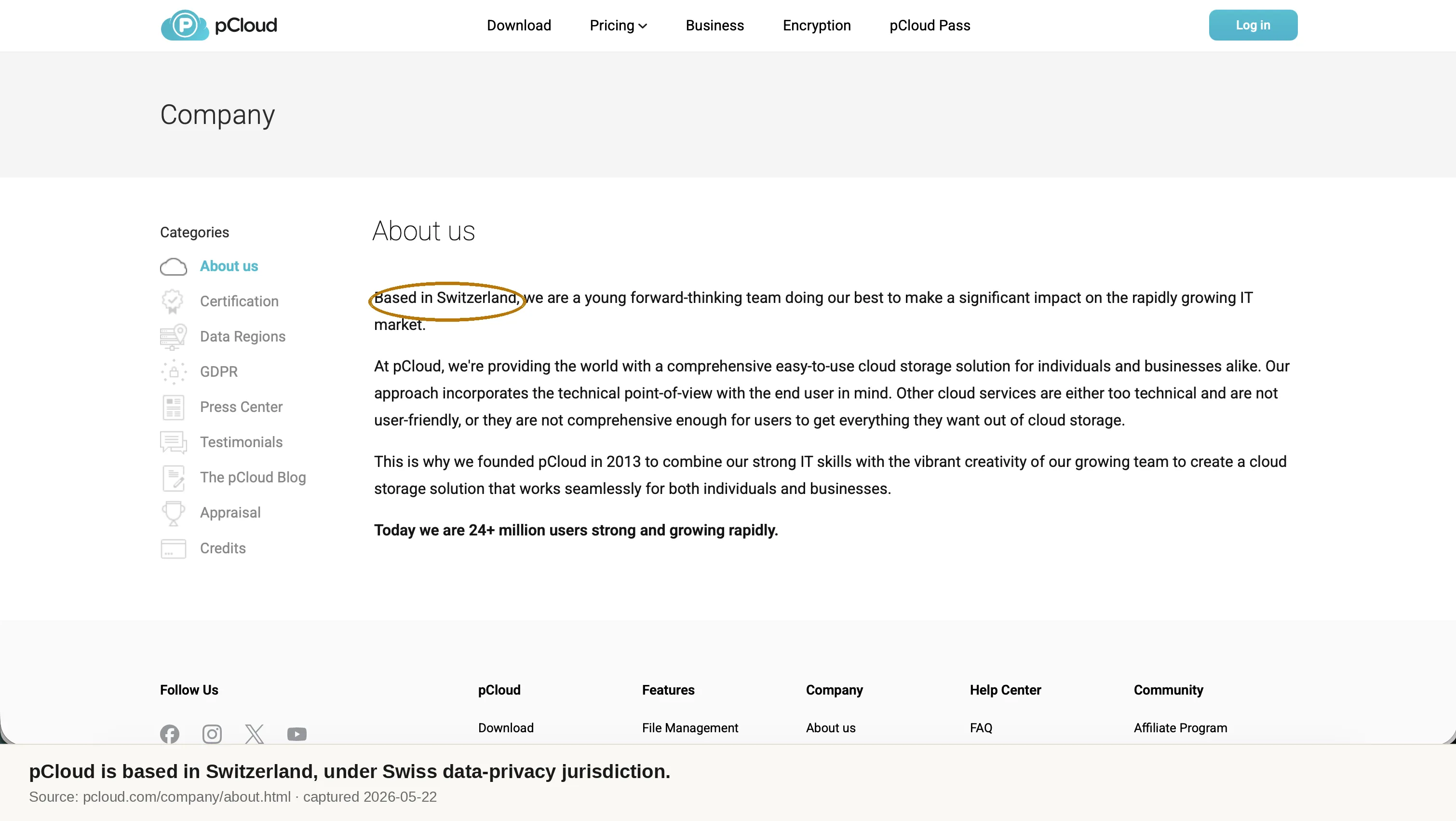
pCloud is a Swiss-based cloud storage service founded in 2013 by Tunio Zafer and Anton Titov. The parent company, pCloud AG, is registered in Baar, Switzerland; the engineering team operates out of Sofia, Bulgaria. As of 2025 it claims more than 22 million users globally. The service offers traditional cloud storage with sync across desktop and mobile, file sharing, a native filesystem mount (pCloud Drive), a media player, an optional zero-knowledge encryption layer (pCloud Crypto), and more recently a bundled password manager (pCloud Pass).
The defining commercial decision pCloud made — and continues to make — is offering Lifetime plans alongside annual subscriptions. Pay once, store forever. This is rare in 2026 because every cloud storage competitor that tried it eventually killed it, citing unsustainable economics. pCloud has held the line for over a decade, which is the main reason it lands on a privacy-and-utility review site at all.
Who it’s for
pCloud is for users who want a generous, paid-once cloud storage account they can keep for years without worrying about subscription creep — and who store ordinary files (photos, documents, project archives, media libraries) rather than nation-state-grade secrets. The typical pCloud Lifetime customer is a photographer who needs to back up a growing RAW library, a small-business owner archiving project files, or a family pooling storage for 3-6 members.
pCloud is not the right choice if your threat model includes a sophisticated adversary attacking the cloud provider directly. The default storage is encrypted-at-rest by pCloud, meaning pCloud controls the keys and could, under legal compulsion or in the event of a breach, expose your data. The Crypto add-on is supposed to fix this, but as discussed in the Weaknesses section, the 2024 ETH Zürich research raises questions that have not been answered. If your data must be unreadable to pCloud itself, look elsewhere.
Pricing
pCloud sells both Lifetime and annual subscriptions. The Lifetime pricing is the real value proposition.
| Plan | Type | Price | Storage |
|---|---|---|---|
| Premium | Annual | $49.99/yr | 500GB |
| Premium Plus | Annual | $99.99/yr | 2TB |
| Premium 10TB | Annual | $299.99/yr | 10TB |
| Premium Lifetime | One-time | $199 | 500GB |
| Premium Plus Lifetime | One-time | $399 | 2TB |
| Ultra Lifetime | One-time | $1,190 | 10TB |
| Family Lifetime | One-time | $595 | 2TB pooled across 5 |
| Crypto add-on | Annual | $49.99/yr | Zero-knowledge folder |
| Crypto Lifetime add-on | One-time | $150 | Zero-knowledge folder |
EUR pricing tracks USD closely; the 2TB Lifetime sticker is roughly €399 in the EU store. Promotional pricing (typically 50% off Lifetime) appears 3-4 times a year, most reliably around Black Friday and the spring. If you can wait for a sale, you almost always should.
The Lifetime math: Google Drive at 2TB costs around $99/year. Dropbox Plus at 2TB costs $119/year. At $399 once, pCloud’s 2TB Lifetime breaks even against Google Drive at year four, against Dropbox at year three and a half. After that, it’s free.
Strengths
Lifetime pricing is a genuine category anomaly. Almost every cloud storage company tried Lifetime plans at some point — and almost all of them killed them as the unit economics became unworkable. pCloud has run Lifetime plans continuously since 2014 and is still selling them in 2026. Whether the underlying business model is sustainable forever is a fair question, but the company has demonstrated more than a decade of operational consistency. For users with multi-year storage needs, Lifetime is the only honest answer to “what’s the cheapest way to store 2TB for 10 years.”
Swiss-parent + EU data region is a meaningful jurisdictional position. pCloud AG is based in Baar, Switzerland — a jurisdiction outside Five Eyes, with strong domestic data protection law and an EU adequacy decision (Swiss data protection considered equivalent to GDPR for transfers). When you sign up, you choose your data region: Luxembourg (EU) or Dallas (US). For European users who want to avoid US legal reach over their data, the EU option matters and is genuinely separate from the company’s Swiss legal entity. Most US-based competitors don’t offer this.
Audit and compliance paperwork is solid for the category. pCloud holds ISO 27001:2013 (information security management), ISO 9001:2008 (quality management), and SSAE 18 SOC 2 Type II. The infrastructure is GDPR-compliant by default, and EU data-region users get the Swiss adequacy decision protections layered on top. None of this is glamorous, but it’s the right paperwork to expect, and many cheaper competitors don’t have it.
Speed beats most privacy-focused competitors in benchmarks. Independent testing consistently shows pCloud at the top of the speed charts for both upload and download against Sync.com, Tresorit, Internxt, and others. The pCloud Drive native filesystem mount means files don’t take up local disk space — they stream on-demand from the cloud — which is genuinely useful for users with large libraries on laptops with small SSDs.
The bundled apps are polished and consistent. Desktop apps for macOS, Windows, and Linux; native iOS and Android; a usable web client. The same workflows work across all of them. For a Lifetime customer who’ll be using the product for years across hardware refreshes, that consistency matters.
Weaknesses
Zero-knowledge encryption is a paid add-on, not the default. When you upload files to pCloud without Crypto enabled, the files are encrypted at rest with AES-256, but pCloud holds the keys and can technically read your data. To get true end-to-end encryption where only you hold the keys, you need to buy pCloud Crypto separately ($49.99/year or $150 lifetime). By contrast, Sync.com and Internxt include zero-knowledge encryption in their standard plans at no extra cost. For users who consider zero-knowledge encryption table-stakes for “cloud storage you can trust,” pCloud’s paywall on it is a structural disadvantage.
The October 2024 ETH Zürich findings against pCloud Crypto are a real story. Cryptography researchers Jonas Hofmann and Kien Tuong Truong of ETH Zürich published a paper identifying multiple cryptographic vulnerabilities in pCloud’s Crypto add-on (and in four other E2EE cloud services). The pCloud-specific findings: unauthenticated key material allowing attackers to overwrite private keys and force encryption with attacker-controlled keys; unauthenticated public keys allowing access to encrypted files; ability to inject files, manipulate metadata, and reorder or remove chunks due to the lack of authentication in chunking. The researchers contacted pCloud in April 2024 through standard coordinated disclosure channels. As of the paper’s publication in October 2024, pCloud had not responded. Public statements from pCloud addressing these findings remain absent at the time of this review. For users relying on Crypto for high-stakes confidentiality, this is the most serious open question in the cloud storage category and we cannot in good conscience minimize it.
pCloud Pass lags badly behind dedicated password managers. pCloud Pass bundles password management with the storage subscription. It does the basics — generation, autofill, encrypted vault — but in 2026 it lacks passkey support, dark-web monitoring, OTP/2FA storage, and rich item types. If you’re paying for a Lifetime plan and treating pCloud Pass as your “free password manager,” you’ll likely find yourself running 1Password, Bitwarden, or Proton Pass alongside it within a few months. Treat pCloud Pass as a bonus, not as a substitute.
Compared to alternatives
In 2026, the realistic comparison set for pCloud is Sync.com, Internxt, and Proton Drive.
Sync.com wins on default privacy — zero-knowledge encryption is included, not an add-on. Sync also stores data in Canada (better than US, weaker than Switzerland on jurisdictional purity). Sync wins for high-stakes confidentiality; pCloud wins on Lifetime pricing, speed, and polish.
Internxt is the European-purity choice: Spain-based, post-quantum cryptography, zero-knowledge default, GDPR-native, with aggressive Lifetime pricing of its own. Internxt is newer and less battle-tested than pCloud, with a smaller user base and shorter operational history. If you trust newer European startups over established Swiss-parent companies, Internxt is the closer fit to “privacy-first by design.” If you want the more mature platform, pCloud is the safer pick.
Proton Drive (included in Proton Unlimited) is the right answer if you’re already buying into the Proton ecosystem. End-to-end encryption is default. The 500GB limit on Unlimited is smaller than pCloud’s 2TB Lifetime tier, but storage is shared with Mail and Calendar in a single subscription. Proton Drive wins for users who want one privacy-first subscription; pCloud wins for users who want maximum raw storage paid once.
Final verdict
pCloud in 2026 is best understood as the answer to a narrowly defined question: “Where do I park 2TB of cloud storage for the next ten years at the lowest possible total cost, with my data under EU law and reasonable security paperwork?” For that question, pCloud’s $399 2TB Lifetime plan beats every alternative on the market, the Swiss-parent + EU-region combination delivers a real jurisdictional benefit, and the speed and platform coverage are genuinely good.
What pCloud is not: a defensible answer to “I need cryptographic certainty that my cloud provider cannot read my files.” The Crypto add-on was supposed to be that answer, but the unresolved ETH Zürich findings and pCloud’s silence on them mean the product currently isn’t deserving of that level of trust. If your threat model genuinely requires zero-knowledge encryption — sources, sensitive case files, anything where exposure has real consequences — choose Sync.com or Internxt and pay the modest premium.
For everyone else: pCloud Lifetime remains the best deal in cloud storage in 2026, full stop.
Try pCloudDisclosure
This review is based on pCloud’s published documentation, the ETH Zürich cryptographic research paper, current pricing pages, the ISO and SOC 2 certifications listed on pCloud’s site, and aggregated independent expert reviews — all verified as of May 2026. privategrade.io earns a commission if you sign up for a pCloud plan via links on this page, and Lifetime conversions are the highest-value commission events on this site — a fact that has not influenced our score. We chose to address the 2024 ETH Zürich findings directly, because editorial credibility matters more than commission rates. See our affiliate disclosure and methodology for the full picture.
Sources verified for this review (May 2026)
- pCloud pricing page — pcloud.com/cloud-storage-pricing-plans.html
- pCloud Lifetime plans page — pcloud.com/lifetime
- pCloud encryption details — pcloud.com/encrypted-cloud-storage.html
- pCloud data regions — pcloud.com/data-regions
- ETH Zürich E2EE cloud storage research (Hofmann & Truong, 2024) — BleepingComputer summary and The Hacker News
- pCloud company background — Wikipedia
- pCloud Pass — pass.pcloud.com