TL;DR
Proton Unlimited is the closest thing on the market to a complete privacy-by-default replacement for Google Workspace, and at €9.99/month on the annual plan it’s priced below most of the single-product alternatives it competes against. The five-app bundle — Mail, Drive, Calendar, VPN, and Pass — is genuinely useful, the encryption is real, and the company is now controlled by a Swiss non-profit foundation rather than venture capital. The biggest 2025 risk — a proposed Swiss surveillance law that would have forced logging — was killed by parliament in December and Proton’s response was strong throughout. If you only buy one privacy subscription this year, this is it.
Try ProtonWhat it is
Proton AG is a Swiss software company that originally built Proton Mail — an end-to-end encrypted email service launched in 2014 by CERN scientists — and has since expanded into a full productivity ecosystem. The current lineup includes Proton Mail, Proton Drive (encrypted cloud storage with Docs and Sheets), Proton Calendar, Proton VPN, Proton Pass (password manager with passkey support), Proton Wallet (self-custody Bitcoin), and most recently Lumo, Proton’s privacy-focused AI assistant.
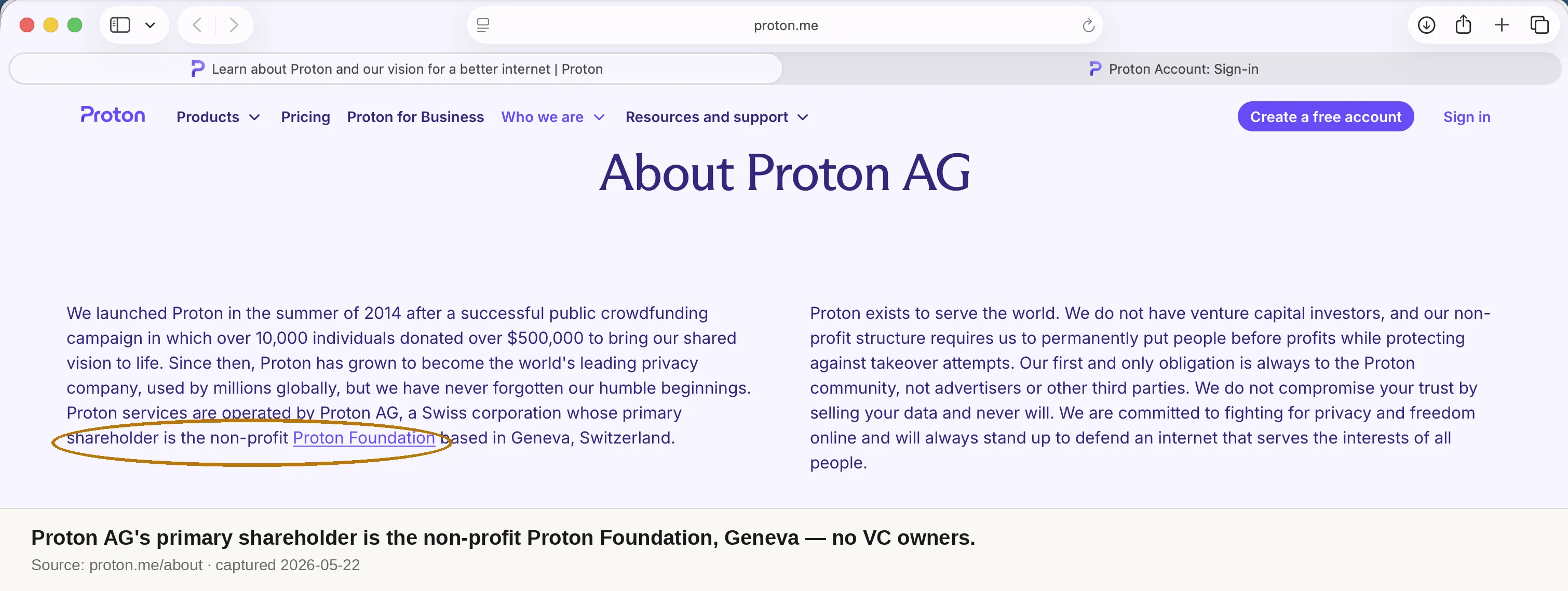
All of these services share a single Proton account and a single subscription. Unlike Google’s “free until we sell your data” model, Proton’s revenue is entirely subscription-based, and as of June 2024 the controlling shareholder of Proton AG is the Proton Foundation, a non-profit registered in Geneva that exists specifically to remove the incentive to monetize user data.
Who it’s for
Proton is for people who want a defensible upgrade over Gmail, Google Drive, and a free password manager, and who are willing to pay roughly €120/year to have all of that in one place under Swiss privacy law instead of US data-broker law. The typical Proton Unlimited user is a freelancer, founder, journalist, lawyer, or developer who has decided that “if you’re not paying, you’re the product” is enough of a problem to actually fix.
If you are an enterprise procurement team, Proton has business plans, but those aren’t the focus of this review. If you are a privacy maximalist who needs subject-line encryption and post-quantum cryptography today, you may prefer Tuta (see below). For everyone in between, Proton hits the right balance of usability and privacy.
Pricing
Proton Unlimited is the plan that actually makes sense for most users. The other tiers either limit you to one product (Mail Plus, VPN Plus, Drive Plus) or scale up to teams (Duo, Family, Business).
| Plan | Annual | Monthly | What you get |
|---|---|---|---|
| Free | €0 | €0 | 1GB Mail, 5GB Drive, basic VPN |
| Mail Plus | €3.99/mo | €4.99/mo | Mail only — 15GB, 10 aliases, custom domain |
| Unlimited | €9.99/mo | €12.99/mo | 500GB shared across all apps, full feature set |
| Duo | €14.99/mo | €19.99/mo | Unlimited for 2 users, 1TB pooled |
| Family | €19.99/mo | €29.99/mo | Up to 6 users, 3TB pooled |
The annual Unlimited price drops to roughly €7.99/month on the 2-year plan if you’re confident enough to commit. Proton does run promotional pricing several times per year (Black Friday and New Year are the deepest), so it’s worth holding out for a sale if you’re not in a hurry.
Strengths
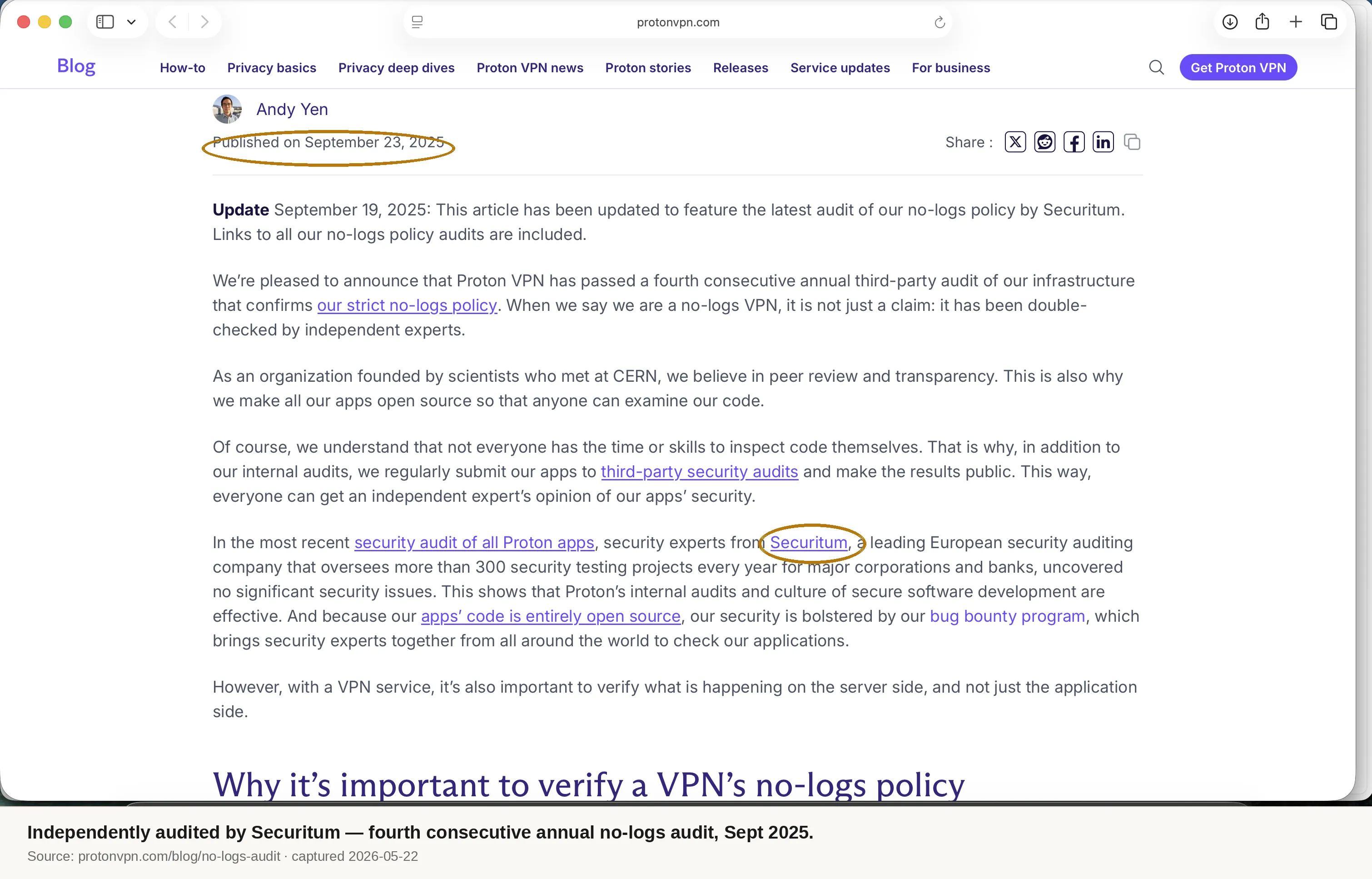
Real, audited encryption at every layer. Mail uses OpenPGP, so messages you send to other Proton users (and to anyone running PGP elsewhere) are end-to-end encrypted by default. Drive, Calendar, and Pass use zero-knowledge encryption where Proton holds only the encrypted blobs. The implementations have been audited by Securitum, an independent European security firm that vetted Proton Mail in 2024 and has run annual no-logs audits on Proton VPN every year since 2022 (the most recent in August 2025). Proton also passed its first SOC 2 Type II audit in 2025 — a B2B-grade security standard most consumer companies don’t bother with. The reports are public.
The non-profit ownership structure is rare and meaningful. Most “privacy-first” companies you’ve heard of are venture-backed and will eventually need a liquidity event. Proton’s controlling shareholder is the Proton Foundation, a Swiss non-profit with no shareholders and a charter to act in the long-term interest of the Proton community. That doesn’t make the company immune to bad decisions, but it does eliminate the most common privacy-degradation pattern in tech: the post-IPO pivot to advertising revenue.
Proton Pass is now competitive with 1Password and Bitwarden. When Pass launched in 2023 it was an obvious “bundled because we had to” product. By 2026 it’s a real password manager: universal passkey support across browsers and platforms (rolled out February 2026), unlimited hide-my-email aliases integrated with Proton Mail, password sharing with expiring encrypted links, dark-web monitoring, and a usable autofill experience on mobile. If you would otherwise pay for 1Password Families (~€4.99/mo), Pass coming “free” with Unlimited materially improves the bundle math.
Proton VPN is the best VPN included in any productivity suite. This isn’t a token throw-in. Proton VPN runs more than 15,000 servers in 110+ countries, has a published transparency report, and is one of the few VPNs with a working free tier that isn’t a dark-pattern funnel. The no-logs policy has been independently verified four years running.
Weaknesses
Subject lines are not encrypted on Proton Mail. This is the single most legitimate criticism. When you send a message to a non-Proton recipient, the message body is encrypted in transit and at rest, but the subject line is stored in the clear on Proton’s servers so that mail clients and search can function. Tuta, Proton’s main competitor, encrypts subject lines and has done so for years. If your threat model involves an adversary with subpoena power who only needs metadata to act, this matters. For most users it doesn’t, but it’s a real product gap and Proton has been promising to address it for several years.
The 500GB pool sounds bigger than it lives. Storage on Unlimited is shared across Mail (with attachments) and Drive (with photo backups, file sync, and now Docs/Sheets). Heavy users — anyone backing up a phone photo library or storing large project archives — will burn through 500GB faster than they expect. The next step up requires the Duo or Family plan, which roughly doubles the price.
The 2025 jurisdictional story is messier than the marketing suggests. Switzerland’s proposed VÜPF amendment would have required VPN and email providers with as few as 5,000 users to log IPs for six months. Proton fought it publicly, joined NymVPN and Threema in the opposition, and moved most of its physical infrastructure out of Switzerland in mid-2025 to insulate itself. The Swiss Parliament effectively killed the amendment on December 10, 2025, accepting a motion to send it back for revision with an estimated two-year delay. Net result: this round was won, but the underlying regulatory pressure isn’t gone, and the Swiss jurisdiction story is more nuanced in 2026 than the simple “Swiss = safe” framing of five years ago. Worth knowing.
It is also worth knowing about the 2021 case where Proton, under a binding Swiss legal order, logged the IP address of a French climate activist’s account. Proton’s response was that no privacy company can refuse to comply with the law of its jurisdiction, the content of emails remained encrypted and inaccessible, and Proton subsequently won a Swiss court ruling that email services are not telecommunications providers under Swiss law. The takeaway: Proton’s encryption is real, but Proton is not above the law and never claimed to be.
Compared to alternatives
The two products people actually weigh Proton against are Tuta (formerly Tutanota) and the incumbent Google/Microsoft stacks.
Against Tuta, Proton wins on breadth (full ecosystem including VPN and password manager vs. Tuta’s mail + calendar + drive), and arguably on usability. Tuta wins on encryption depth (subject lines encrypted, post-quantum cryptography rolled out ahead of competitors) and on jurisdiction philosophy — though Tuta is based in Germany, a Fourteen Eyes country, which is itself a non-trivial weakness. If you only need email and want the strongest individual product, choose Tuta. If you want a Google Workspace replacement, choose Proton.
Against Google/Microsoft, the comparison isn’t close on privacy and isn’t really a debate. The interesting question is whether Proton’s productivity tools (Drive, Docs, Sheets, Calendar) are good enough that you don’t miss the incumbents. Mail and Calendar: yes, comfortably. Drive: yes for sync, syncing-PDFs use cases; thinner for real-time collaboration with non-Proton users. Docs and Sheets: usable but clearly v1, and a long way behind Google Docs for collaborative editing.
Final verdict
Proton Unlimited in 2026 is the best privacy-first software subscription you can buy as an individual. The €9.99/month annual price is below most single-product alternatives, the company structure is genuinely aligned with users in a way almost no other “privacy” company can claim, and the 2025 regulatory crisis ended up reinforcing rather than weakening the offer. Subject-line encryption and post-quantum cryptography are the legitimate gaps; everything else either ties or beats the field.
If you’re already paying for any combination of a password manager, a VPN, encrypted cloud storage, or a private email service, do the math on what those individual subscriptions cost and compare to €9.99/month. The bundle almost always wins, and the privacy guarantee is the part you can’t buy à la carte.
Try ProtonDisclosure
This review is based on Proton’s published security documentation, the Securitum and SOC 2 audit reports linked above, Proton’s current pricing pages, and aggregated independent expert reviews — all verified as of May 2026. privategrade.io earns a commission if you sign up for a Proton plan via links on this page; the commission rate does not influence our score or the products we choose to cover. See our methodology and affiliate disclosure for the full picture.
Sources verified for this review (May 2026)
- Proton pricing page — proton.me/pricing
- Proton Mail security audit (Securitum, 2024) — proton.me/blog/security-audit
- Proton VPN no-logs audit (Securitum, August 2025) — securitum.com
- Proton SOC 2 Type II announcement — proton.me/blog/soc-2
- Proton Foundation structure (June 2024) — proton.me/foundation
- Proton Pass passkeys (February 2026) — proton.me/blog/proton-pass-passkeys
- Swiss VÜPF amendment killed in parliament (December 10, 2025) — techradar.com
- 2021 climate activist case — Proton’s official response at proton.me/blog/climate-activist-arrest